
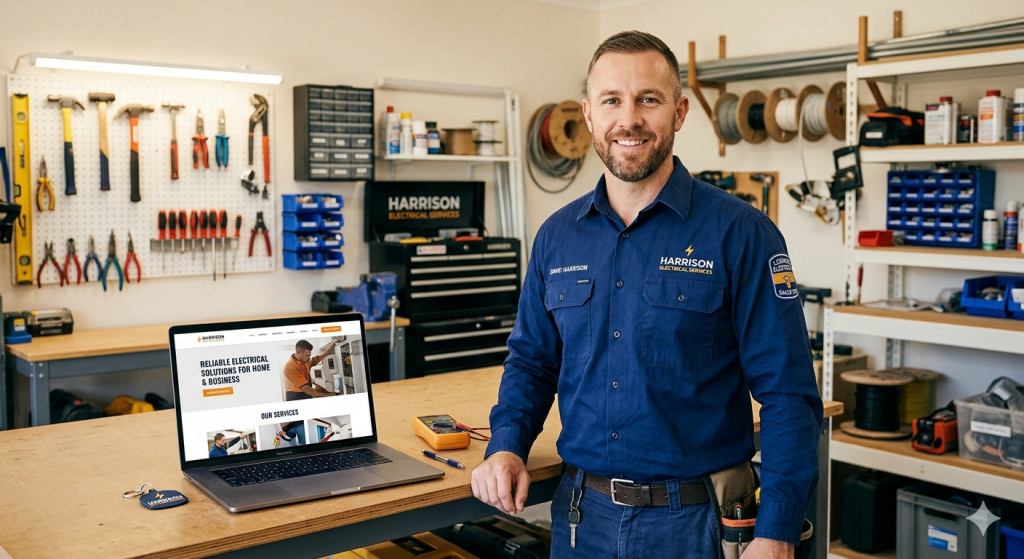
An electrician website builder isn’t a luxury anymore — it’s the single most leveraged investment you can make for your trade business in 2026.
Think about the last time you needed a plumber, a roofer, or yes, an electrician. Did you flip open the Yellow Pages? Ask your neighbor first? Probably not. You Googled it. You scanned the top results. You clicked the one that looked professional. And within 90 seconds, you either called them — or moved on.
Your potential customers are doing the exact same thing to you right now.
This guide isn’t a generic pitch about “having an online presence.” It’s a practical, in-depth breakdown of why electricians who build strong websites win more work, charge higher rates, and grow faster — and exactly how to make it happen, even if you’ve never built a website before.
Table of Contents
- The Invisible Electrician Problem
- What Customers Actually Do Before Calling
- 7 Reasons an Electrician Website Builder Changes Everything
- What the Best Electrician Websites All Have in Common
- How to Choose the Right Website Builder for Your Electrical Business
- Local SEO: The Secret Weapon for Electricians
- Real-World Example: Before vs. After a Website
- Common Mistakes Electricians Make With Their Websites
- Getting Started: Your Action Plan
- Final Thoughts
1. The Invisible Electrician Problem {#invisible}
Here’s a scenario that plays out thousands of times a day across every city and suburb.
A homeowner’s circuit breaker trips repeatedly. It’s a Sunday afternoon. They pull out their phone, type “emergency electrician near me,” and scroll through the results. The top three listings have websites with reviews, service pages, and a phone number front and center. The fourth result — a name, a phone number, no website — gets skipped entirely.
That fourth electrician might be the most skilled one in the area. Doesn’t matter. Without a web presence, they’re invisible.
This is called the invisible electrician problem, and it affects an enormous percentage of trade professionals. According to BrightLocal’s Local Consumer Review Survey, over 98% of consumers used the internet to find local business information in the past year. For service businesses like electricians, that number is even more pronounced because the need is often urgent — people aren’t leisurely browsing, they need someone now.
An electrician website builder solves this problem directly. It takes you from invisible to findable in days, not months.
2. What Customers Actually Do Before Calling {#customer-behavior}
Understanding your customer’s digital journey is half the battle. Here’s what actually happens before someone picks up the phone to call an electrician:
Step 1 — They search. Google, Bing, or even voice search via Alexa or Siri. Queries like “licensed electrician [city name],” “EV charger installation near me,” or “electrical panel upgrade cost” are typed every single minute.
Step 2 — They scan results. Studies from Nielsen Norman Group show users spend an average of 10–20 seconds deciding whether a website is worth their time. First impressions are instant.
Step 3 — They check your credibility. License numbers, insurance info, certifications (like a NICEIC, NAPIT, or state licensing badge), Google reviews — these are what customers look for to feel safe hiring a stranger into their home.
Step 4 — They contact you. But only if steps 1–3 go smoothly.
If you don’t have a website, you’re removed from this journey entirely at Step 1. A good electrician website builder ensures you show up, look credible, and make contact effortless.
3. 7 Reasons an Electrician Website Builder Changes Everything {#7-reasons}

Reason 1: You Control Your First Impression
A Facebook page or Google Business Profile is better than nothing, but you don’t control the design, the layout, or the messaging. A website built with a dedicated electrician website builder gives you full ownership of that first impression.
You decide what customers see first — whether that’s a bold headline about 24/7 emergency service, a gallery of completed panel upgrades, or a row of five-star reviews. That control is the difference between a prospect feeling confident and feeling uncertain.
Reason 2: You Appear in Local Search Results
Google’s local algorithm rewards businesses with complete, professional web presences. When someone searches “electrician in [your city],” Google looks at signals like: do they have a website? Is it mobile-friendly? Does it load quickly? Is the business name, address, and phone number consistent across the web?
An electrician website builder handles most of these technical requirements automatically — mobile optimization, fast loading, structured data — so you can compete in local search without hiring a developer.
Reason 3: You Generate Leads While You Sleep
Word-of-mouth requires someone to actively recommend you. A website works 24/7. A homeowner who discovers a flickering light at 11pm can visit your site, read about your emergency services, and submit a contact form before they go to bed — and wake up to a new job lead in your inbox.
This passive lead generation compounds over time. The more content and reviews your site accumulates, the more Google trusts it, and the more organic traffic it attracts — without you spending anything on ads.
Reason 4: You Can Charge More
This might surprise you: electricians with professional websites consistently command higher rates than those without one. Why? Because a well-designed website signals expertise and legitimacy. Customers aren’t just paying for the work — they’re paying for the confidence that the job will be done correctly and safely.
A polished portfolio of past projects, clear explanations of your certifications, and professional branding communicate value before you’ve even answered the phone. Customers who find you via your website have already pre-qualified themselves; they’re not shopping on price alone.
Reason 5: You Build a Reviews Ecosystem
Online reviews are the new word-of-mouth, and your website is the hub that ties everything together. A well-configured electrician website builder lets you display Google reviews directly on your site, adds a link to your Google Business Profile to encourage new reviews, and builds social proof automatically.
According to Podium’s State of Reviews report, 93% of consumers say online reviews impact their purchasing decisions. Electricians with 20+ reviews and a professional website are dramatically more likely to get the call than competitors with none.
Reason 6: You Can Target Specialty Services
General “electrician near me” searches are competitive. But niche service pages — “EV charging point installation in [city],” “smart home rewiring specialist,” “commercial lighting upgrade contractor” — are far less competitive and convert at higher rates because the searcher’s intent is very specific.
A good electrician website builder makes it easy to create individual service pages for each of your specialties, effectively multiplying how many search queries can lead a customer to your business.
Reason 7: You Future-Proof Your Business
The trades are evolving. EV adoption is accelerating. Smart home technology is moving into mainstream renovation projects. Battery storage systems are becoming common. The electricians who build authority online now — creating content, earning reviews, establishing domain age — will have a massive head start when homeowners begin searching for these next-generation services.
An electrician website builder is the foundation of that long-term digital authority.
4. What the Best Electrician Websites All Have in Common {#best-sites}
After analyzing dozens of high-performing electrician websites, several patterns emerge. These aren’t design opinions — they’re conversion-driving features that the data consistently supports.
A clear, immediate value proposition. The headline on your homepage should tell visitors exactly who you serve, what you do, and where you do it. “Licensed Residential & Commercial Electrician Serving Phoenix, AZ” beats “Welcome to Our Website” every single time.
A prominent phone number. Not buried in the footer. At the top of every page, clickable on mobile, visible immediately. When someone needs an electrician, friction is your enemy.
A service area page or section. Google rewards geographic specificity. List every suburb, neighborhood, or city you serve. This simple addition can dramatically expand your local SEO footprint.
Photo galleries of real work. Stock photos don’t build trust. A photo of a neat, professional panel installation you completed last week does. Before-and-after photos of rewiring projects are especially compelling.
Clear credentials and licensing info. License numbers, insurance certificates, trade association memberships — display them visibly. This reduces the single biggest objection in the hiring decision: “Is this person qualified and safe?”
A frictionless contact experience. A contact form is the minimum. Consider adding live chat, a text/SMS option, and clear business hours. The easier it is to contact you, the more contacts you’ll receive.
5. How to Choose the Right Website Builder for Your Electrical Business {#choose}
Not every website builder is appropriate for trade businesses. General-purpose platforms like Wix or Squarespace can work, but they require significant customization to be effective for an electrician. Trade-specific website builders have templates pre-built for the way electrical businesses actually operate.
Here’s what to look for:
Trade-specific templates. Look for layouts that include service list sections, before/after galleries, license/credential displays, and emergency service callouts. Starting from a template designed for your industry saves hours of setup.
Built-in booking or quote request forms. Customers want to request quotes online. A builder with native form functionality — ideally with email and SMS notifications — turns visitors into leads automatically.
Local SEO tools. Does the builder let you edit page titles, meta descriptions, and URL slugs easily? Can you add structured data (schema markup) for local businesses? These aren’t advanced features — they’re table stakes for ranking locally.
Speed and mobile performance. Google’s Core Web Vitals now directly influence ranking. Choose a builder with a proven track record of fast, mobile-optimized sites. Test the demo sites on Google’s PageSpeed Insights before committing.
Managed hosting and security (SSL). The last thing you want is to worry about server maintenance or security certificates. Good builders include these automatically.
→ best website builders for tradespeople
Local SEO is the process of optimizing your website so it appears when people search for electricians in your geographic area. For most electricians, this is more valuable than any paid advertising.
Here’s a practical local SEO checklist for your electrician website:
Claim and fully optimize your Google Business Profile. This is free and has an outsized impact on whether you appear in the “map pack” — the three businesses displayed at the top of local search results. Ensure your name, address, phone number (NAP), website URL, and business hours are exactly consistent with what’s on your website.
Create location-specific pages. If you serve five cities, create a unique service page for each. Each page should include the city name, the services you offer there, and ideally a testimonial from a customer in that area.
Build local citations. List your business on directories like Angi (formerly Angie’s List), HomeAdvisor, Houzz, Yelp, and your local Chamber of Commerce. Each consistent citation reinforces your legitimacy to Google.
Earn and respond to reviews. Ask every satisfied customer to leave a Google review. Respond to every review — positive or negative. This activity signals to Google that your business is active and engaged.
Publish locally relevant content. A blog post titled “5 Signs Your Home in [City Name] Needs a Panel Upgrade” will rank for long-tail local queries that your competitors almost certainly haven’t targeted.
7. Real-World Example: Before vs. After a Website {#example}
Consider the experience of a sole-trader electrician in a mid-sized city — let’s call him Marcus. Before his website, Marcus relied entirely on word-of-mouth. He had steady work but hit a ceiling: he was fully booked through referrals in busy seasons and scrambling in slow periods. He had no way to attract new customers and no control over the type of work coming in.
After building a website using a trade-specific electrician website builder, Marcus added service pages for EV charger installation and smart lighting systems — two growing market segments he wanted to move into. Within three months:
- His Google Business Profile views increased by 180%
- He started receiving 4–6 inbound quote requests per week from organic search
- Two of those requests were for EV charging installations — his highest-margin service
The website didn’t replace his referral network. It amplified it. Now when someone gets referred to Marcus, they Google him first. They find a professional site with 40+ reviews and a portfolio of recent work. The referral converts at a much higher rate because the website has already done the trust-building work.
8. Common Mistakes Electricians Make With Their Websites {#mistakes}
Knowing what to avoid is just as valuable as knowing what to do. These are the most common errors that undermine electrician websites:
Using a generic template with no trade-specific customization. A website that looks like it could belong to a florist or a consultant doesn’t reinforce that you’re a licensed professional in a technical trade. Use a template built for electricians, then customize it with real photos and specific service details.
Neglecting mobile users. More than 60% of searches for local services happen on mobile devices. If your site is hard to navigate on a phone — small buttons, hard-to-read text, no click-to-call functionality — you’re losing the majority of your potential customers.
Hiding contact information. Some builders place the phone number only in the footer. That’s not good enough. It should be in the header, on every page, and it should be a tappable link on mobile.
Ignoring page speed. A site that takes more than 3 seconds to load will lose visitors. Google research shows that the probability of a mobile visitor bouncing increases 32% as page load time goes from 1 second to 3 seconds.
Never updating the site. A website with a copyright date from five years ago or a blog with no posts since 2021 sends a subtle but damaging signal. Google favors fresh, active sites. So do customers.
9. Getting Started: Your Action Plan {#action-plan}
If you’re ready to build — or rebuild — your electrician website, here’s a practical starting point:
- Choose a trade-specific electrician website builder with built-in local SEO tools, mobile optimization, and service templates.
- Claim your domain name using your business name or a relevant keyword phrase (e.g., yourbrandelectrical.com or [cityname]electrician.com).
- Set up a professional email address on your domain (e.g., info@yourbusiness.com) — this alone increases perceived credibility.
- Build your core pages first: Home, Services, About, Service Area, Contact. These five pages are enough to start ranking and converting.
- Add real photos — even smartphone photos of your work are better than stock images.
- Optimize your Google Business Profile and ensure NAP consistency between your profile and website.
- Ask your last 10 customers for a Google review — this single action can transform your local search visibility within weeks.
- Publish one blog post per month targeting a specific local question or service. Consistency beats volume here.
10. Final Thoughts {#conclusion}
The electricians who thrive in 2026 aren’t necessarily the most skilled ones in their area — though skill obviously matters. They’re the ones who make it easy for customers to find them, trust them, and hire them.
An electrician website builder is the most direct path to that outcome. It levels the playing field against larger competitors, amplifies your word-of-mouth referrals, creates a 24/7 lead generation engine, and builds the kind of digital trust that turns first-time callers into long-term clients.
The hardest part isn’t building the website. The hardest part is deciding to stop being invisible.
If you’re ready to take that step, start with a builder designed specifically for the electrical trade — one that handles the technical complexity so you can focus on what you do best: the work.
Have questions about building your first electrician website? Drop them in the comments below — or explore more trade business marketing guides here at codethesiss.com.




2 Comments
Your comment is awaiting moderation.
Nicely explained, even beginners can follow this.
Your comment is awaiting moderation.
https://shorturl.fm/wbG2z
Your comment is awaiting moderation.
https://shorturl.fm/KrFJt
Your comment is awaiting moderation.
https://shorturl.fm/LlE64
Very nice post. I just stumbled upon your weblog
and wished to say that I have truly enjoyed surfing around your blog posts.
In any case I will be subscribing to your
feed and I hope you write again very soon!
[…] can be used as a standalone theme or as a plugin alongside any existing WordPress theme. Its inline editing lets you click directly on any element and edit it right there — no separate […]